04
What Tokenisation Actually Does (and Doesn’t)
A substitute number can limit the damage of a copied credential. It does not change who owes the money.
The receipt from a shop you visited once shows a payment, but the number on the receipt is not the one printed on your card. Something in the middle swapped the credential.
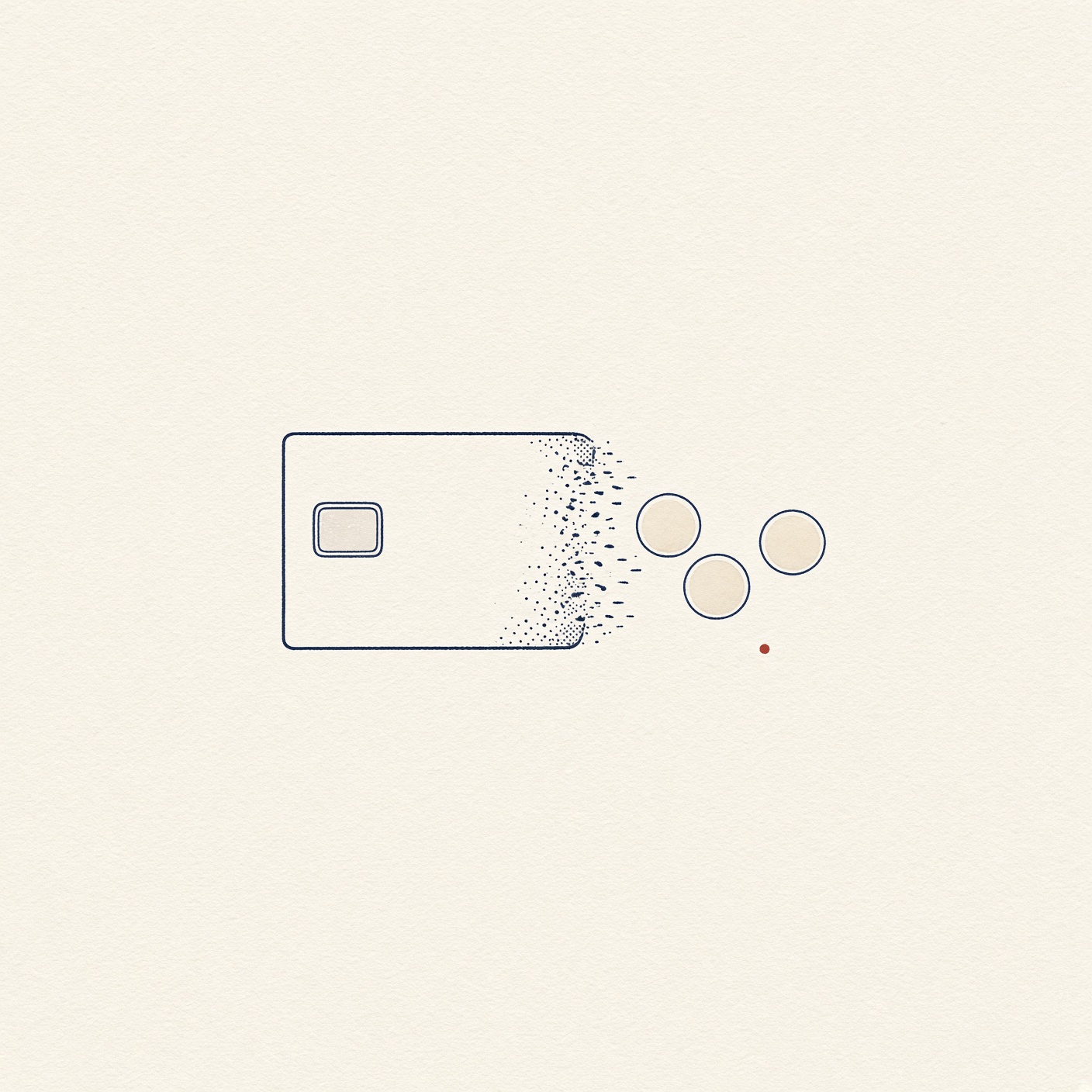
Tokenisation replaces a card number with a substitute, called a token, for a particular use. The shop, the wallet, or the card network stores the substitute. The full number stays with the issuer or with a token service the issuer trusts. If the substitute leaks, it can be turned off. The plastic does not have to be reprinted for every incident, and a token meant for one device is less useful to someone who only has the number.
There is more than one kind. A device token is bound to a phone or a watch. A merchant token is bound to a shop you have paid before, which is why a returning checkout can succeed after you have replaced the card. An online checkout may use either, or it may still ask for the full number and never tokenise it at all. The word on a marketing page does not tell you which of these you are looking at.
What tokenisation does not do is just as important. It does not prove that you meant the purchase. It does not stop a payment from an unlocked phone in someone else’s hand. It does not hide the transaction from your issuer, and it does not change the dispute rules on the account. A tokenised payment can still be a mistake, a subscription you forgot, or a charge you intend to challenge.
The trade-off is a narrower secret in exchange for another party in the chain. When a token fails, the failure can look like a decline even though the card is valid. Replacing a phone can strand a merchant token until the issuer or the wallet maps it again. You may see a pending charge under a name you do not recognise because the token’s descriptor and the shop’s name are not the same.
Networks and issuers do not implement this the same way in every country. Some domestic schemes tokenise in-person taps and leave online payments on the full number. Some issuers let you see and delete tokens in the banking app. Others show only the original card. If you cannot tell whether a checkout stored a token or the full number, ask. The answer changes what you should do when a merchant’s records are copied.
Take these with you
Questions worth asking your provider
Prompts for a conversation with the institution that holds the account. They are not a checklist that makes one product suitable.
- 01Is this payment using a device token, a merchant token, or the full card number?
- 02Who can delete the token if the device or the merchant is no longer trusted?
- 03Will replacing the phone or the card break a payment you still want?
- 04Does tokenisation change how you dispute a charge on this account?
This note is general information. It is not financial, legal, or tax advice, and it is not a recommendation to open, close, or change an account.